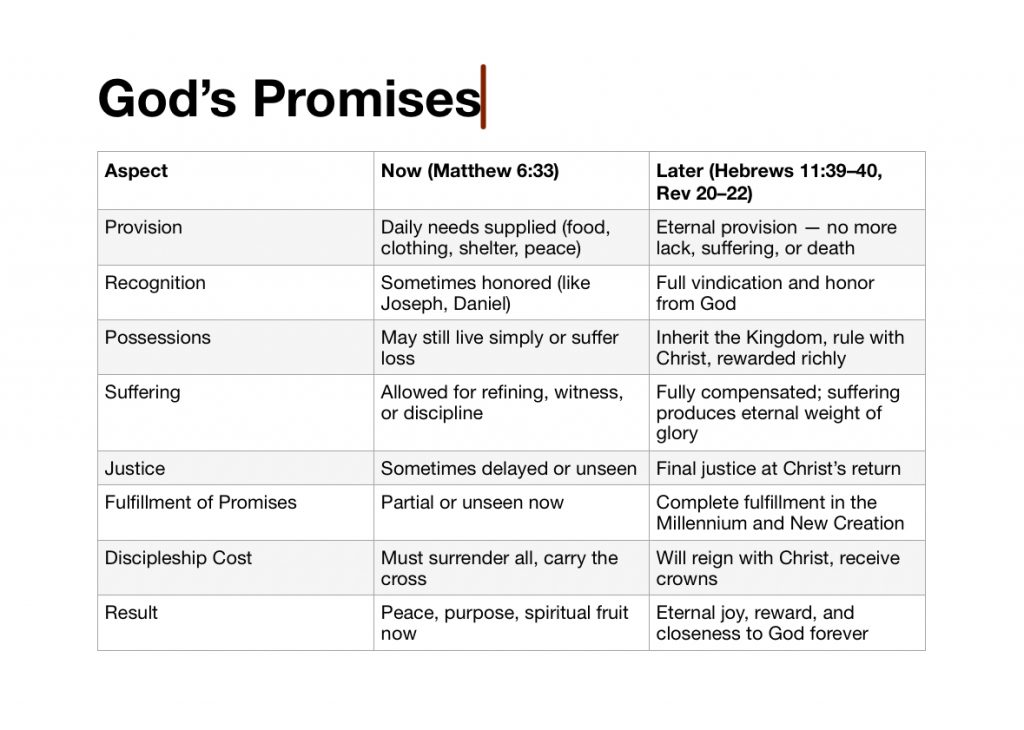
In our Christian walk in life living as exiles on earth, the Lord God had made several promises and rewards to the faithful. Some promises and rewards will not be fulfilled in this life but in the coming Millennium and New Creation. I have listed the promises for several aspects of our lives – provision, recognition, possessions, suffering, justice and discipleship cost.
“Therefore go and make disciples of all nations, baptizing them in the name of the Father and of the Son and of the Holy Spirit, and teaching them to obey everything I have commanded you. And surely I am with you always, to the very end of the age.”
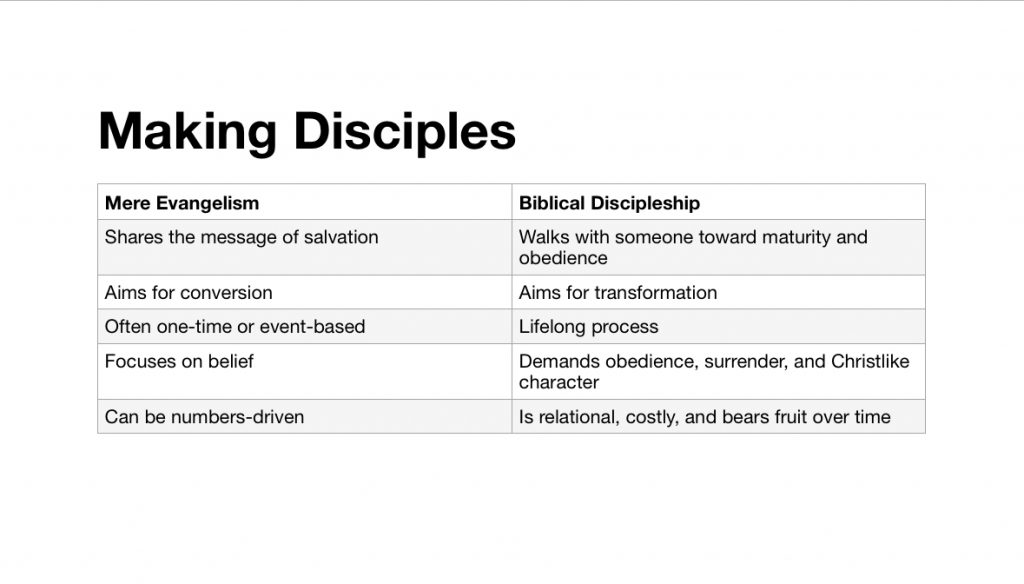
We are commissioned to go and make disciples, and not merely sharing the gospel. Sharing the gospel is only the starting point of true disciple making.
Many churches and ministries today stop at “decisions for Christ” but Jesus our Lord called for making disciples who live under His Lordship. Without emphasising the cost of discipleship, we risk creating a shallow Christianity that lacks endurance, fruit and holiness.
Postscript :
Even if one obeys the Great Commission to go and make disciples, can he or she make disciples if he or she is not one in the first place ? Our Lord had given 3 demands of discipleship in Luke 14:26,27 and 33. If he or she cannot fulfil these 3 demands, can he or she considered himself or herself a disciple ?
If one has true or legitimate faith in Christ, he will abide in Him and produce true fruit and in turn, he will have true freedom in Him.
True Faith
Hebrews 11:13–16 teaches that true faith looks beyond this world. It believes God’s promises even when they are not yet fulfilled, lives as a pilgrim and stranger on earth, and seeks a better, heavenly country.
True faith does not turn back to the old life but presses on toward God’s eternal city. Because such people desire God above all, He is not ashamed to be called their God, and He prepares a place for them.
True Fruit
Jesus warned in Matt 7:21-23 that not everyone who calls Him “Lord” or performs miracles in His name will enter the Kingdom. Spiritual power can impress, but it does not prove a true relationship with Him.
The Lord looks for the fruit of repentance — a heart changed by the Spirit. True fruit is not seen in signs and wonders but in obedience, humility, mercy, and love.
As Jesus said, “I am the vine; you are the branches… apart from Me you can do nothing.” (John 15:5)
When we abide in Christ, His life flows through us, producing lasting fruit — the character of Christ in us.
True Freedom
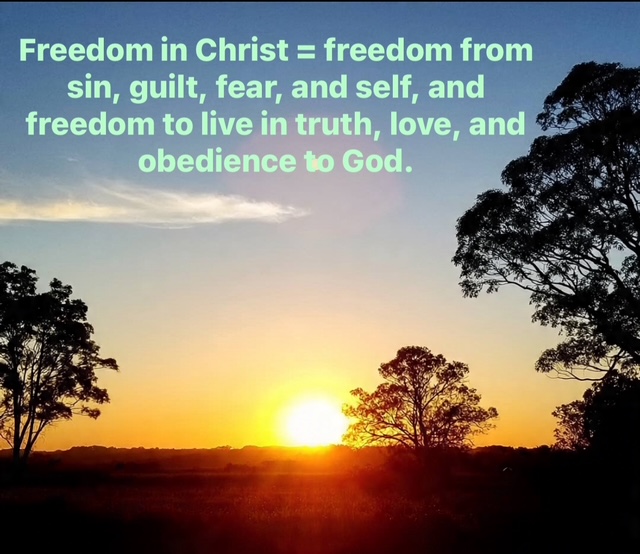
Many seek freedom — freedom from rules, from people’s expectations, from pressure. But the freedom the world offers is an illusion. It often leads us deeper into bondage — bondage to sin, fear, guilt, and self.
Christ offers a different kind of freedom. Through His death and resurrection, He broke the chains of sin that enslaved us. No longer do we have to live under guilt or condemnation. In Him, we are forgiven, accepted, and loved.
This freedom is not a license to do whatever we please. It is the power to live as we were meant to — walking in truth, loving others, and serving God from a willing heart. The Spirit now writes God’s law on our hearts, and we obey not out of fear, but out of love.
True freedom is being released from self-centered living so that we may live for Christ and His kingdom. It is freedom from fear and striving, replaced by peace, joy, and purpose in the Holy Spirit.
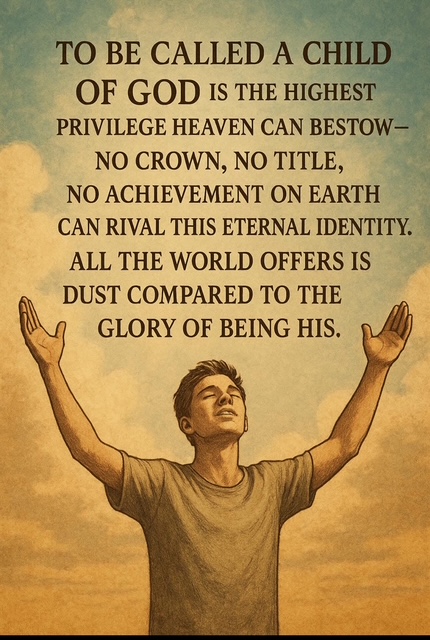
No treasure, title, or triumph in this world can equal the gift of being called a child of the Most High. it is not merely an honour – it is the ultimate fulfilment of human destiny, the very reason we exist. Nothing, absolutely nothing, on earth can rival this eternal identity. All the world offers is dust compared to the glory of being His. This one gift – to be known by God, loved as His child – outshines all the accolades of men.
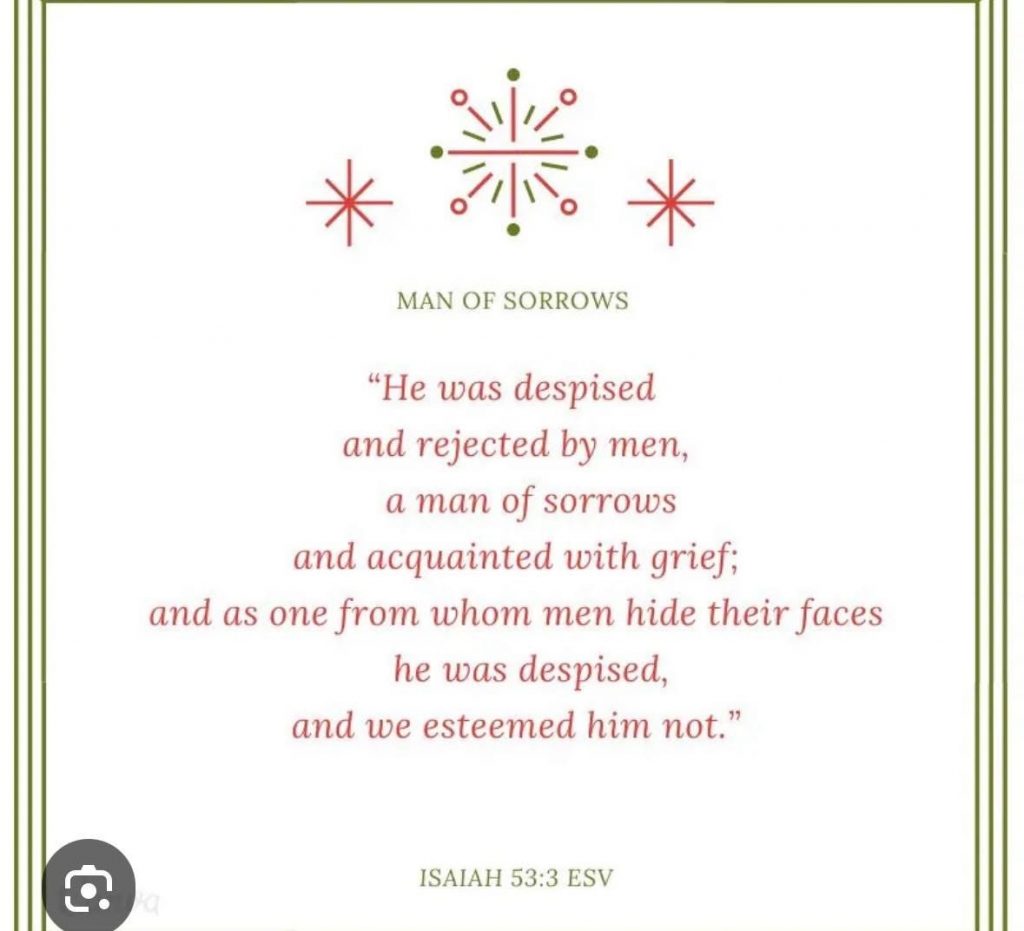
You may feel like the darkness will never go away and have no more strength to continue. You are not alone. There is One Person who sees every tear, hears every silent cry, and He whispers,”Come to Me. I will give you rest.” His name is Jesus. He knows what it feels like to be rejected, abandoned, even crushed. Though He was called the Man of Sorrows, yet He carried your sorrow to the cross. He died—not because you are a failure, but because you are deeply loved. And He rose again so that your story doesn’t need to end in pain or death, but in healing, peace, and a new beginning. Please don’t give up.You may not see it now, but your life is precious in His eyes.You are not forgotten and forsaken. And you don’t have to walk this valley alone. Jesus is here. Let’s walk together with Him who love us so much.
The Heb 11 faith chapter presents two groups of the faithful and they are specifically mentioned in verses 32 to 40. This passage helps me to understand the perennial tension between the continualists and the cessationists today.
The first group (verses 32-35a) are the ones who experienced miraculous victories and deliverance. They conquered kingdoms, obtained promises, stopped the mouths of lions, escaped the edge of the sword and received back their dead by resurrection.
The second group (verses 35b-38) were also commended for their faith but their experience was very different – they were tortured, refusing to accept release, mocked and flogged, killed with the sword, went about destitute and wandering in deserts and mountains.
The Continualists emphasize the ongoing miraculous works of the Spirit – healing, prophecy, tongues, signs etc and this mindset resonates with the first group where faith leads to visible triumphs and miracles.
The Cessationists believe that certain supernatural gifts ceased after the apostolic age. Many of them focus on endurance, fidelity to Scripture, and suffering for Christ and aligns more closely with the second group where faith is shown through perseverance under persecution and loss, without necessarily seeing outward miracles.
This Scriptural passage gives no superiority to either group. Both were commended through their faith (verse 39). The miracle-receivers and the martyr-sufferers are equally honored. In fact, both groups are seen incomplete without us – pointing to something greater in God’s plan (verse 40).
In conclusion, Scripture is certain that faith is not validated by visible outcomes, where miracles occur or not. God works both through signs and through silence. Faith, in both cases, is what pleases Him.
Postscript : I must mention that the NAR movement is in neither of these 2 groups. If we test them by the criteria of a different gospel, different Jesus and different spirit – namely the way of Cain, Balaam’s error and Korah’s rebellion – these so called prophets and apostles are found wanting. I am not surprised that many are already being exposed for their immorality and lack of integrity.
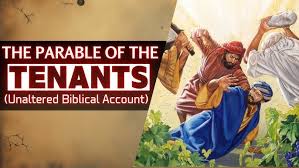
In the parable stated in Matt 21:33-46, Mark 12:1-12 and Luke 20:9-19, the vineyard represents national Israel (cross ref : Isaiah 5:7), the tenants are Israel’s religious leaders, the servants are the prophets whom the leaders rejected and killed, the son is Jesus and the owner is God who will destroy the tenants and give the vineyard to others.
When Jesus our Lord said that the Kingdom of God would be taken away and given to a people producing its fruits, He was not talking about real estate (the land of Israel) being permanently taken away but about stewardship over God’s kingdom – specifically the spiritual leadership and privilege of representing God’s rule on earth. In Matt 21:43, the Kingdom of God is being taken away from corrupt Jewish leaders and given to others who will bear its fruit referring to the apostles, the early Jewish believers and eventually Gentile believers grafted into the people of God (Rom 11).
This parable does not teach that Israel is rejected forever. Rom 11:1 stated clearly that God has not rejected His people and Rom 11:25-26 stated only a partial hardening has come upon Israel until the fullness of Gentiles has come in and then all Israel will be saved. God’s covenant with Israel is not nullified. There will be a future restoration promised.
In summary, the parable is about spiritual leadership and not permanent loss of land. It warns that rejecting God’s Son leads to loss of kingdom responsibility. The Kingdom message moves from rebellious leaders to faithful people – who follow Jesus.
Element
Symbol
Old Tenants (Rejected)
New Tenants (Accepted)
Vineyard
God’s covenant people / kingdom
Israel entrusted to religious leaders
The Church – all who follow Jesus
Owner
God
Sends prophets and His Son
Still the same Owner – God remains faithful
Servants
Prophets
Beaten, rejected, killed
Honored by the faithful
Son
Jesus Christ
Killed outside the vineyard (Jerusalem)
Believed, loved, followed
Tenants
Leaders/stewards
Chief priests, scribes, Pharisees
Apostles, Jewish believers, and Gentiles in Christ
When it was announced that the covid 19 mRNA vaccines were ready in early 2021, we were convinced by the authorities that the efficacy of these mRNA vaccines was 95%. The clinical trials of Pfizer were conducted this way. 2 groups of 20,000 volunteers participated with one group vaccinated while the other did not. 8 and 162 persons were infected from the vaccinated group and the non vaccinated group respectively.
Efficacy of the vaccine = 1 – 8/162 x 100 = 95%
Out of caution, I hesitated to take the vaccination till 50% of the nation’s population was fully vaccinated as announced by the authorities in their official website. The cumulative figures of infection in that week were :
Fully vaccinated (2 jabs) : 412 out of 2.5 million
Partially vaccinated (1 jab) : 283 out of 0.5 million
Non vaccinated : 253 out of 2.0 million
Looking squarely at the above statistical data, it was very strange that the partially vaccinated had the highest percentage of infection among the three groups. If we leave out the partially vaccinated figures, using the above formula in calculating the efficacy of the vaccine,
Efficacy = 1 – 412 /253 x 100 = – 63%
That was a red flag for me. Instead of even getting zero efficacy, the actual efficacy was negative 63% implying that the vaccinated was more likely to spread the disease. Later, the authorities changed their narrative that the vaccine did not prevent transmission but protect against hospitalization and death. It would be too far-fetched or bizzare for me to believe that the vaccine, which could not prevent the first line of defense against transmission, but could prevent the second or third line of defense of hospitalization and death. Since the population was over 90% vaccinated, there was no control group for comparison to make such assumption.
Later, the authorities informed that the killed virus vaccine such as the China made vaccines were inferior to the Pfizer mRNA vaccine. That defied common sense again. How could the killed virus vaccine, which presented the whole real virus but killed as not to cause disease, be inferior to the mRNA vaccine, which was only producing one spike protein of the virus ? Won’t a person’s immune system trained by the killed real virus vaccine recognize the same real virus better when he is exposed to the real virus than trained by the simulated single spike protein vaccine bearing no semblance to the real virus ? The authorities also informed that natural immunity was inferior. That was also bizzare for me. It is like someone who has actually won a real fight against the enemy, and will he not better trained in future fights against the same enemy than just learning to fight in a simulated situation ? Some 9000, who suffered severe side effects from the first mRNA vaccine jab since rollout, were told by the authorities to complete. their vaccination regimen by taking the Sinovac killed virus vaccine. Was it not telling us that the killed virus vaccine was safer ?
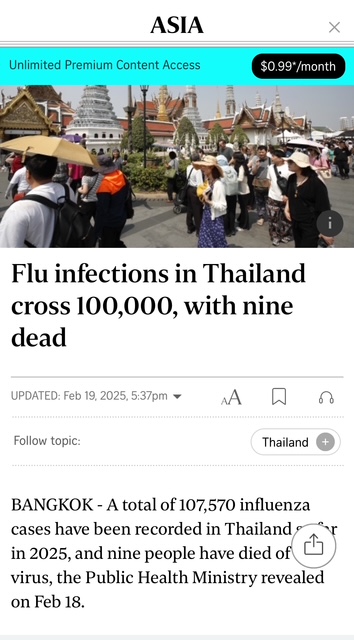
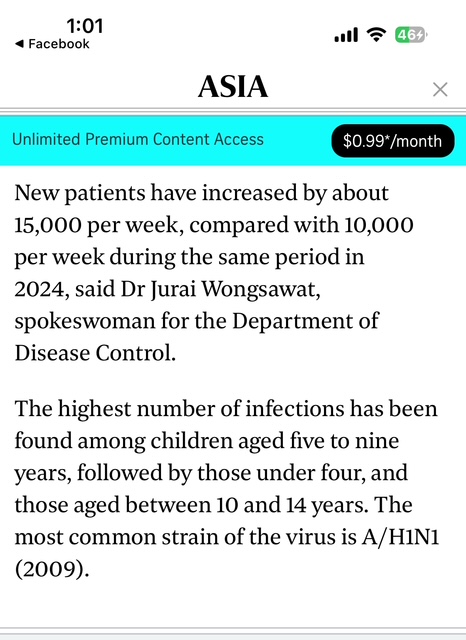
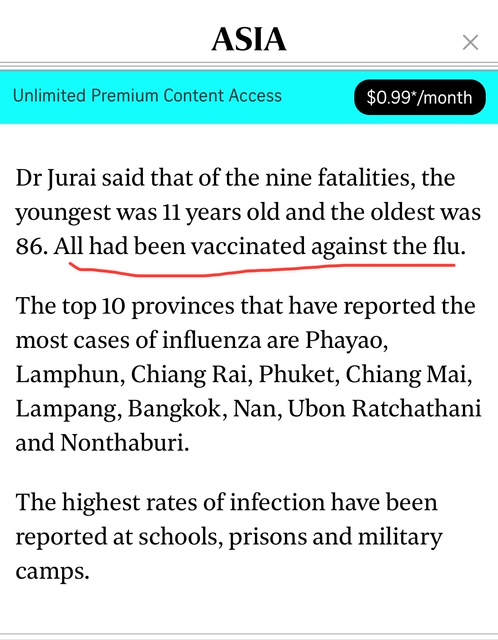
Fast forward to 19 Feb 2025 when the Straits Times newspaper reported that 100,000 people in Thailand were infected with flu since the start of 2025 and there was 9 fatalities which all 9 fatalities were vaccinated.
Due to the kiasu nature of the Singapore population, 32% were vaccinated upon learning of the death of a very famous Taiwanese actress Barbie Hsu due to pneumonia. I could safely assume that the Thailand population had lower vaccination rates below 20%. Common sense interpreting the above data should tell us that the flu vaccine was not only not effective but might possibly weaken the immune system where all the deaths came from the very small vaccinated percentage. (Does not this statistics cast doubt on the earlier premise that mRNA vaccine does not prevent transmission but does prevent death ?)
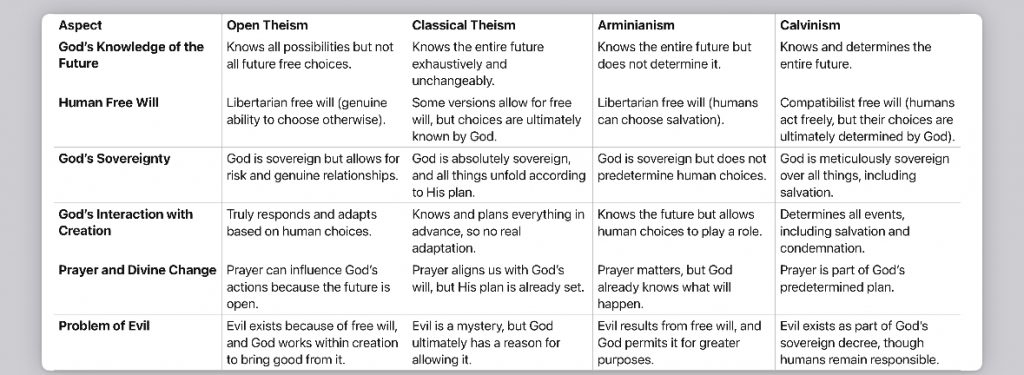
Open theism is a theological view that emphasizes God’s dynamic relationship with creation, particularly regarding human free will and the nature of the future. It asserts that :
God is Omniscient but the Future is Partially Open.
Open theists believe that God knows everything that can be known, but because the future includes free choices that have not yet been made, it is not fully determined and therefore, not fully knowable.
2. Genuine Free Will.
Human beings have real freedom to make choices, which means their decisions are not pre-determined by God. This view contrasts with classical theism, which holds that God’s foreknowledge includes all future events.
3. God Can Change His Plans.
Since the future is not entirely fixed, God can interact with humanity in real time, responding, adapting and even changing His course of action based on human choices and prayers.
4. God’s Sovereignty includes Risk.
Unlike traditional views that depict God as meticulously controlling everything, open theism suggests that God, in His sovereignty, allows for uncertainty and risk, valuing genuine relationships with His creatures.
Open theism is often contrasted with classical theism (which holds that God knows the future exhaustively) and is debated among theologians, with critics arguing that it undermines God’s omniscience and sovereignty. However, supporters believe it better aligns with biblical depictions of God’s relational nature and human responsibility.
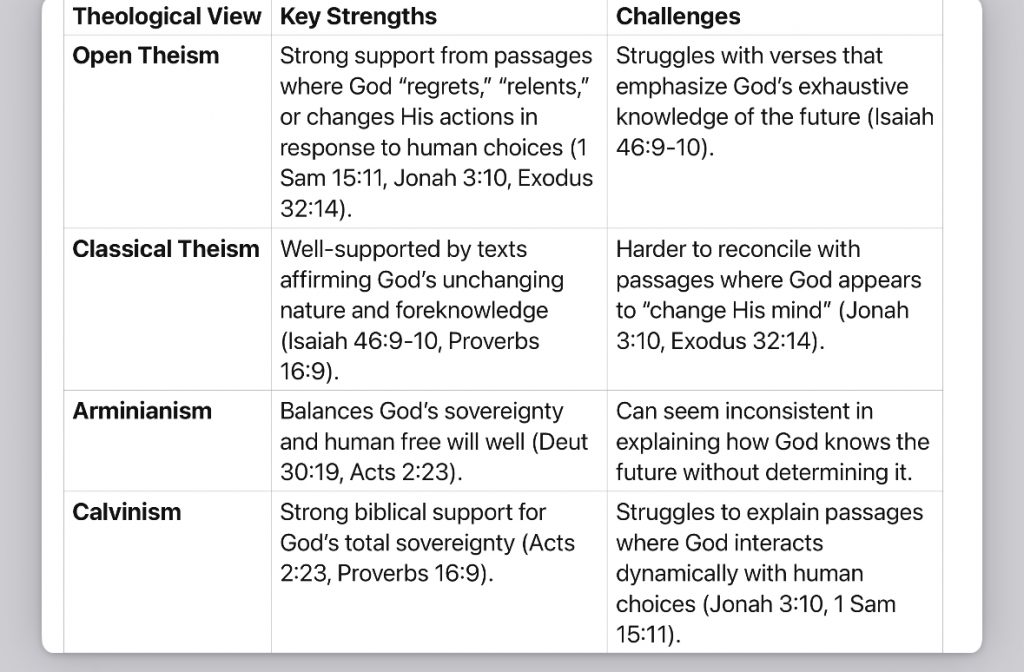
(See Table 1 for the comparison of Open Theism with Classical Theism, Arminianism and Calvinism.)
Let’s see how the various views interpret the following verses.
God’s Knowledge of the Future.
Isaiah 46:9-10. “I am God, and there is none like me, declaring the end from the beginning and from ancient times things not yet done.”
Classical Theism And Calvinism. Strongly supports God’s exhaustive foreknowledge and sovereignty over all history.
Arminianism. Affirms that God knows the future, but human free will is still intact.
Open Theism. Open theists interpret this as God declaring His ultimate plan, not every single human choice.
1 Samuel 15:11. “I regret that I have made Saul king, for he has turned back from following me.”
Classical Theism & Calvinism. View this as anthropomorphic language – God is expressing disappointment but knew this would happen.
Arminianism. Acknowledges that God foresaw Saul’s rebellion but still allowed him free will.
Open Theism. Suggests that God’s plans can change based on human actions, meaning the future is not entirely pre-determined.
2. Human Free Will.
Deut 30:19. “I have set before you life and death, blessing and curse. Therefore choose life, that you and your offspring may live.”
Classical Theism & Calvinism. Accepts human choices but interprets them as working within God’s ultimate plan.
Open Theism & Arminianism. Strongly supports libertarian free will – humans can genuinely choose their destiny.
Acts 2:23. “This Jesus, delivered up according to the definite plan and foreknowledge of God, you crucified and killed by the hands of lawless men.”
Calvinism. Shows that God’s sovereignty includes determining major events like Jesus’ crucifixion.
Classical Theism & Arminianism. Supports foreknowledge but does not necessarily mean predestination of all things.
Open Theism. Might argue that God’s plan involved sending Jesus, but human choices (e.g. Judas’ betrayal) were not fully determined.
3. God’s Sovereignty vs Human Responsibility.
Proverbs 16:9. “The heart of man plans his way, but the Lord establishes his steps.”
Calvinism & Classical Theism. Strongly supports God’s control over human decisions.
Arminianism. Suggests God allows human plans but still guides history.
Open Theism. Could interpret this as God influencing but not dictating outcomes.
Jonah 3:10. “When God saw what they did, how they turned from their evil way, God relented of the disaster that he had said he would do to them, and he did not do it.”
Classical Theism & Calvinism. Argue that this is God revealing His unchanging character rather than literally “changing His mind”.
Arminianism. Agrees that God takes human repentance into account but still knows the final outcome.
Open Theism. Strongly supports the idea that God responds dynamically to human actions.
4. Prayer And Divine Change.
Exodus 32:14. “And the Lord relented from the disaster that he had spoken of bringing on his people.”
Classical Theism & Calvinism. God’s “relenting” is seen as part of His eternal plan rather than a true change in decision.
Arminianism. Prayer is significant, but God already knows the outcome.
Open Theism. Prayer genuinely influences God’s actions, showing an open future.
James 5:16. “The prayer of a righteous person has great power as it is working.”
Classical Theism & Calvinism. Agrees but believes God already knew the prayers and included them in His plan.
Arminianism. Accepts that prayer is powerful but within God’s foreknown will.
Open Theism. Supports the view that prayer makes a real difference.
The early Christians were persecuted throughout the first three centuries under the Roman Empire for refusing to worship the Roman gods and the Emperor. The worst period of persecution was under Emperor Diocletian from 303 to 311 AD. It ended when the next emperor Constantine signed the Edict of Milan in 313 AD. He convened the first of seven ecumenical councils in Nicaea in 325 AD.
Christianity was made the state religion in 335 AD, and the first Christmas celebration was celebrated by the early Christians thereafter in 336 AD. There was about a few hundred churches scattered across the whole Roman Empire then and there was no central authority. The fourth ecumenical council of Chalcedon was held at a later date in 381 AD implying that there was still no central papal authority then. Our formal doctrines were derived from these ecumenical councils especially that of Nicaea and Chalcedon.
The bishop of Rome gained prominence over other bishops primarily because it was the capital of the Roman empire then before it moved to Byzantium which was renamed Constantinople. The church of Rome was the first to celebrate the Christmas before the few hundred churches also celebrated over time. How did the individual church bishops arrive at such a decision to celebrate the Lord’s birthday based on theological or liturgical reasons was still debatable because it was not determined at any of the seven ecumenical councils. Papal authority was only formalized in 440 AD under Pope Leo I which was more than 100 years after the first celebration.
It is clear that neither the state nor the later papal authority started the first Christmas celebration but rather the early Christians in Rome.
To me, the Christmas celebration is a matter of conscience just like whether we should eat food offered to idols. Scripture did give us clear instruction on such matter of conscience. The small budding church in Ephesus faced such dilemma on whether to eat food offered to idols which was sold in marketplaces or being invited to feast by pagan friends. In my opinion, one will be making a wrong turn to contend against each other on such matter of conscience. After the Reformation, the Lutheran church continued to celebrate Christmas proving that the matter of conscience of Christmas celebration was not in conflict with the matter of truth detailed in the five solas.