Why Keep Contending Against False Gospel And False Christology

Acts 20: 26 – 31

26 Therefore I testify to you this day that I am innocent of the blood of all, 27 for I did not shrink from declaring to you the whole counsel of God. 28 Pay careful attention to yourselves and to all the flock, in which the Holy Spirit has made you overseers, to care for the church of God, which he obtained with his own blood. 29 I know that after my departure fierce wolves will come in among you, not sparing the flock; 30 and from among your own selves will arise men speaking twisted things, to draw away the disciples after them. 31 Therefore be alert, remembering that for three years I did not cease night or day to admonish every one with tears.

Jude 1: 3 – 4

Beloved, although I was very eager to write to you about our common salvation, I found it necessary to write appealing to you to contend for the faith that was once for all delivered to the saints. For certain people have crept in unnoticed who long ago were designated for this condemnation, ungodly people, who pervert the grace of our God into sensuality and deny our only Master and Lord, Jesus Christ.

2 Tim 2: 15

15 Do your best to present yourself to God as one approved, a worker who has no need to be ashamed, rightly handling the word of truth.

Eph 4: 14

14 so that we may no longer be children, tossed to and fro by the waves and carried about by every wind of doctrine, by human cunning, by craftiness in deceitful schemes.

James 5: 19 – 20

19 My brothers, if anyone among you wanders from the truth and someone brings him back, 20 let him know that whoever brings back a sinner from his wandering will save his soul from death and will cover a multitude of sins.

The contention for truth against a different Jesus and a different gospel is of paramount importance because it concerns eternal life and death.  But overbearing contention for any whim and fancy of tradition or matter of conscience is a different matter altogether and it belongs to an unrighteous critical spirit instead.

We are most uncharitable as Christians if we do nothing to bring back brothers who have wandered from the gospel truth and do not do our best to save their souls from death.

http://www.godtube.com/watch/?v=WL6YPLNX
 

JC1


Confirm Your Calling And Election

2 Pet 1:3-11

His divine power has granted to us all things that pertain to life and godliness, through the knowledge of him who called us to his own glory and excellence, by which he has granted to us his precious and very great promises, so that through them you may become partakers of the divine nature, having escaped from the corruption that is in the world because of sinful desire. For this very reason, make every effort to supplement your faith with virtue, and virtue with knowledge, and knowledge with self-control, and self-control with steadfastness, and steadfastness with godliness, and godliness with brotherly affection, and brotherly affection with love. For if these qualities are yours and are increasing, they keep you from being ineffective or unfruitful in the knowledge of our Lord Jesus Christ. For whoever lacks these qualities is so nearsighted that he is blind, having forgotten that he was cleansed from his former sins. 10 Therefore, brothers, be all the more diligent to confirm your calling and election, for if you practice these qualities you will never fall. 11 For in this way there will be richly provided for you an entrance into the eternal kingdom of our Lord and Savior Jesus Christ.

His divine power has granted to us all things that pertain to life and godliness. (2 Pet 1:3).   Firstly,  the gospel is the power of God granted for eternal life in Christ Jesus (Rom 1:16) and secondly,  His precious promises are the power of God granted for growing godliness in Christ Jesus. (2 Pet 1:4).   Chief among the precious promises are the ministry of the Holy Spirit and the correction and instruction of the Word of God.

God will not make us holy against our will and without our involvement though He has given us all things necessary for us to become more and more like Christ.  We must want it and we must make every effort through discipline in supplementing our faith in Christ with the following graces of holiness :

  1. Virtue. Moral excellence which is also spiritual courage to stand for what is right.
  2. Knowledge. Knowledge of spiritual truth which can only come through studying and obeying the Word of God.
  3. Self control. We must have discipline in feeding on the Word of God, prayer, curbing our appetites and giving sacrificially.
  4. Steadfastness. Patient endurance in the face of persecution and adversity as the world will hate us on the account of our Lord and the gospel.
  5. Godliness. Our godly conduct will show others that we are truly children of God.
  6. Brotherly affection. When we love one another,  others will know we are the disciples of Christ.
  7. Love. Love for the brothers will lead to love for all man.

We must be diligent in practicing these qualities otherwise we will regress.  There is no standstill.  Either we advance or retreat in our path of discipleship in knowing our Lord more and more and be like Him. 2 Pet 1:8.  Retreat will lead to shortsightedness, blindness and forgetfulness.  2 Pet 1:9.

And if we practice these qualities diligently, we will never fall.   2 Pet 1:10.

hs


Facing Argument Tricks Contending For The Truth

In contending against false teaching over the years,  I have tried my best to show the whole counsel of the Word of God concerning the true gospel and Christology.  Yet the defenders of the false gospel such as hyper grace gospel usually resorted to the following argument tricks.

I am contending for the gospel and Christology truth because it concerns eternal life and death and I will be most uncharitable not to try to bring back those who have wandered from the truth and will face the second death.  I am always wondering even if the defenders of the false gospel and false Christology are to wear me down with the following argument tricks, what profit is there for them ?

(The definition of the terms are gleaned from various internet sources such as Wikipedia.)

1.  Red Herring.  It is a kind of fallacy that is an irrelevant topic introduced in the argument to divert the attention of readers from the original issue.

2. Argumentum Ad Hominem. It is a logical fallacy in which an argument is rebutted by attacking the character, motive or other attribute of the person making the argument, or persons associated with the argument, rather than attacking the substance of the argument itself.

3. The Straw Man Argument. It deliberately misrepresents and weakens the argument of the opposing side by leaving out key points of an opposing argument, quoting a person’s words out of context, or presenting a particular person’s poor defense as the entire defense of an opposing side.

4. Weak Analogy Argument. It is used to prove or disprove an argument, but the analogy is too dissimilar to be effective, that is, unlike the argument more than it is like the argument.


Sectarian Spirit

Mark 9:38-40
John said to him, “Teacher, we saw someone casting out demons in your name, and we tried to stop him, because he was not following us.” But Jesus said, “Do not stop him, for no one who does a mighty work in my name will be able soon afterward to speak evil of me.  For the one who is not against us is for us.

Prior to these verses, we saw the immaturity of the disciples in failing to cast out demons and arguing who was the greatest.  And now they possessed a sectarian spirit.

Today, there are some evangelicals who will go around discrediting all charismatics as though they belong to the devil. Some charismatics are merely doing great works in the mighty name of our Lord in casting out demons or prophesying for the good of Christendom. Yet they are discredited like as though they are preaching a false gospel or living in sin.

(Side note :  I say some charismatics and not all because I am also disgusted with pagan-like signs and wonders which may be demonic in nature. Such abuse should not be the reason to discredit all charismatics and all spiritual gifts.)

It seemed to me in the above Scriptural passage that the only qualm was those casting out demons were not a team with the apostles. That was all. Jesus our Lord had clearly said that these people who did mighty works in His name were not damaging His name and would surely not speak ill of Him.

(Side note :  Though I agree that the signs and wonders performed by the apostles were to substantiate their apostleship,  we saw from this Scriptural passage that others, not traveling with Jesus our Lord and the apostles, could also perform mighty works in His name which our Lord did not deny.)

On the contrary, I am wondering today if those, who harbor such critical sectarian spirit, are being influenced by the enemy instead to deprive God of the glory for such works. Matt 5:16.

We must have a good balanced stance. Like for the gift of prophecy, do not despise straightaway. Test all of them and hold fast what is good as exhorted by Scripture. 1 Thess 5:20-21.


On Law-works And Faith-works

Rom 4: 2-5
For if Abraham was justified by works, he has something to boast about, but not before God. For what does the Scripture say? “Abraham believed God, and it was counted to him as righteousness.” Now to the one who works, his wages are not counted as a gift but as his due. And to the one who does not work but believes in him who justifies the ungodly, his faith is counted as righteousness.

James 2: 21-23
Was not Abraham our father justified by works when he offered up his son Isaac on the altar? You see that faith was active along with his works, and faith was completed by his works; and the Scripture was fulfilled that says, “Abraham believed God, and it was counted to him as righteousness”—and he was called a friend of God.

On the cursory reading of these 2 passages, they seem to contradict each other. But if we delve further into the wider context of these 2 passages, we will soon realize that the Works mentioned are different. I will call the Works in Romans as Law-works while that in James as Faith-works.

In Romans, Paul was addressing the Jews who might still be trying to earn their salvation by law-works in keeping the Halakha, the Jewish Law, which includes 613 prohibitions so devised as to comply with the Mosaic Law, the Ten Commandments. But we read in Phil 3:4-6 that Paul could be blameless in keeping this Jewish Law like many Pharisees at that time and yet he persecuted the church. The Pharisees could keep the Jewish Law meticulously yet their hearts were not repentant – they were lovers of money, mean-spirited and self righteous. They could go through the physical circumcision meticulously but their hearts were not circumcised.

In James, James was not talking about keeping this Jewish Law but about Action or Faith-works which will prove that Faith is legitimate. He quoted 2 examples of legitimate faith in Abraham and Rahab. One was about to perform child sacrifice and the other committed treason – not good works exactly. But their action proved that they believed God and it was counted to them as righteousness.

Right Giving – An Act Of Devotion To God

Luke 21:1-4 NASB
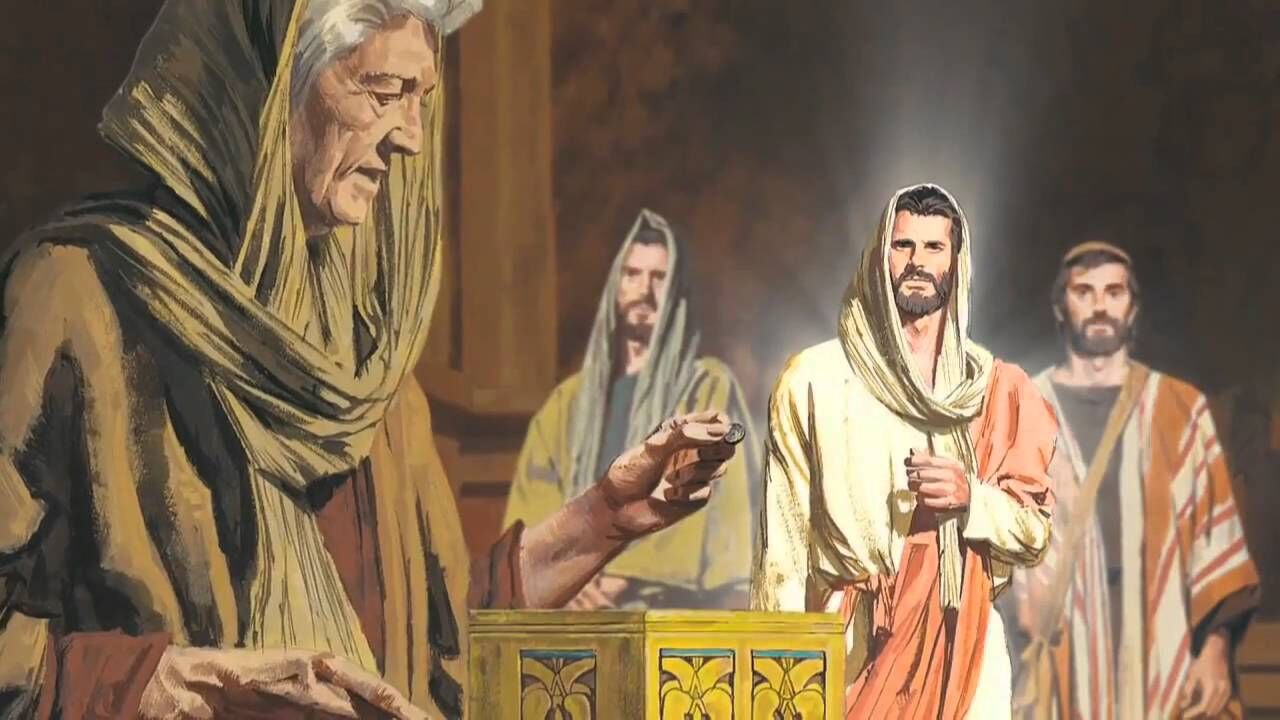
And He looked up and saw the rich putting their gifts into the treasury. And He saw a poor widow putting in two small copper coins. And He said, “Truly I say to you, this poor widow put in more than all of them; for they all out of their surplus put into the offering; but she out of her poverty put in all that she had to live on.”

This passage clearly reminds us that our offering is only meaningful to God out of a genuine love for Him and not with any other selfish or covetous motive. In Matt 6:1-4, Jesus our Lord already told us that if our giving is to draw and gain recognition from others, our giving will not be acceptable to God. Jesus specifically said that the poor widow gave more than all of the rich that day. Obviously He was not referring literally to the physical absolute amount of money given. Jesus, in His omniscience, even knew the 2 copper coins were all she had to live on.

Jesus is watching intently on our motives for giving our offering today as well. Let’s be sure on this first fact that Jesus our Lord uses a different criterion to weigh our giving – on our hearts and on not our gifts – unlike the tangible criterion the world uses.

Similarly, Jesus weighs on our repentance and not on our works, or on the circumcision of our hearts and not physical circumcision pertaining to our response to the gospel.

What the poor widow put into the treasury was considered more than all the rich Jews put. So let’s be sure that it is not the physical amount Jesus weigh on but the right motive or attitude in giving. The poor widow gave out of poverty while the rich Jews gave out of surplus – contrasting extremes which our Lord always loved to use to illustrate His teachings. The only qualm I can see about the rich giving out of surplus in this incident is probably a nonchalant performance of duty and not an act of devotion, unlike the poor widow. Then consider this : how contemptible it will be if the rich actually give with a covetous heart that God will reward him or her with even more when he or she is already very well off !

Let’s look at the first fallacy.

Jesus would be wrong to commend that the poor widow gave more if this false teaching of the growth formula (growth of multiple fold to what one gives) is to be believed because the poor widow would gain the least among all who gave that day. The real motivation behind such call to sow miracle seed is to raise as much funds as possible for the church and this objective can only be achieved by stoking the greed in the members to give more in physical amount and be rewarded in kind by God. Pittance giving will be considered a nuisance to the fund raising exercise.

On the second fallacy, this false teaching promises deliverance from poverty for sacrificial giving to the church. If it is true, the poor widow should not remain poor all this while till Jesus saw her. If she was giving for the first time, it would be a first time jackpot hit and Jesus was not really omniscient to know. Definitely not the first time because she was a Jew and not young since she was a widow. And if she had been giving with such commendable attitude all this while, then why was she still poor ? Do you follow ?

When the rich gave, the gifts would not hurt them a bit for it would be a pittance of their surplus. But when the poor widow gave, she probably had to go hungry that day for that was all she had to live on. Hallelujah ! The poor widow was really wise to see that storing treasure in Heaven, and not on earth, would last. Her physical hunger was nothing compared to her hunger for God. That was an excellent act of devotion to God. Besides she had survived all this while on little showing she had no lack by the grace of God though she was poor.

Let’s emulate the poor widow in giving out of love for God instead of covetous motive.w1

Putting On Christ

When we believe in Christ, His righteousness is imputed on us. Legally, God sees us as righteous in Christ because of His perfect atonement for our sins.  And He will continue His workmanship in us in training us to conform to Christ.

Rom 8:30.  And those he predestined, he also called; those he called, he also justified; those he justified, he also glorified.

There are two kinds of response to this training of putting on Christ or dressing up as Christ.  One is the sincere response of a true believer while the other is the insincere response which will put justification in Christ in doubt in the first place.

One is the hyper grace way. It is simply a wolf putting on the sheepskin of the Lamb of God and pretending to be a sheep. The wolf does not want to change his wolf ways and yet he enjoys pretending to be a sheep.

The other is the true grace way. One day, the wolf seriously want to be a sheep giving up his wolf ways. (This response to turn from its wicked ways is Repentance.) Yet it is a tough journey for he is still a wolf after all. But he can be a transformed wolf one day becoming truly a sheep in every sense and loving the sheep. The good kind of pretense is that the wolf starts by acting like a sheep living among sheep.

CS Lewis said this about pretense, “There are two kinds of pretending. There is a bad kind, where the pretense is there instead of the real thing; as when a man pretends he is going to help you instead of really helping you. But there is also a good kind, where the pretense leads up to the real thing. When you are not feeling particularly friendly but know you ought to be, the best thing you can do, very often, is to put on a friendly manner and behave as if you were a nicer person than you actually are. And in a few minutes, as we have all noticed, you will be really feeling friendlier than you were…”

But the wolf will realize very soon that he is not alone in this journey of the good pretense.

The Christ Himself, the Son of God who is man just like you and me, will actually be his side to turn his pretense into a reality.

You may suspect it is the conscience of the wolf helping him. If it is conscience, very soon, the wolf will realize he will get back to old comfortable ways he is familiar. And many “wrong” things the wolf does, his conscience will actually tell him it is perfectly okay because he is a wolf after all.

CS Lewis said this about the good pretense turning into reality with Christ at our side, “For you are no longer thinking simply about right and wrong; you are trying to catch the good infection from a Person. It is more like painting a portrait than like obeying a set of rules. And the odd thing is that while in one way, it is harder than keeping rules, in another way it is far easier. He is turning us into the same kind of thing as Himself.”

He is ‘injecting’ His kind of life and thought into us, turning us from real wolves into real sheep at the end of the day.

Can A Christian Lose His Or Her Salvation ?

The debate on the eternal security of a Christian and the possibility of a Christian losing his or her salvation has never been conclusive for clear Scriptural references have been put forth in support of both position.  A better re-phrased question to ask is : How is a Christian justified by faith ?

I believe the crux lies in repentance.  Repentance and saving faith are two sides of the same coin.  Though the Greek word for repentance, metanoia, means a change of mind, the Bible is very clear that repentance involves fruit or deed in line with it. Luke 3:8-14; Acts 26:20; Acts 3:19. In Acts 2:38, we are told to repent and be baptized in the name of our Lord Jesus for the forgiveness of sins, and then to receive the Holy Spirit.

So a true believer changes his mind from rejection of Jesus Christ into full acceptance of Him as his personal Savior and Lord. And a true change of mind will result in a changed life. 2 Cor 5:17; Gal 5:19-23; James 2:14-26.

But even this repentance is the work of God in our lives starting from disbelief changing into knowledge with God pulling us and then to wisdom when He opens our eyes. Eventually convicting us to make that decisive response of following Jesus as our Savior and Lord.

A Christian is not pre-disposed to sin anymore. Though he sins occasionally due to temporary weakness or strong temptation, his life is overall walking right with God. A good example is King David. 1 Kings 15:5 clearly explained that : For David had done what was right in the eyes of the Lord and had not failed to keep any of the Lord’s commands all the days of his life—except in the case of Uriah the Hittite. When his sin was pointed out, his immediate response was to realize his sin, feel godly sorrow and seek God’s forgiveness. That is the overall life of a regenerate believer.  (For full clarity, read the whole epistle of 1 John.)

An unregenerate believer or a professing believer is one who is overall indifferent to sin. You will notice his chronic sinful behavior. You will notice most, if not all, his decisions are worldly and not according to the instruction in the Bible.

(1 Cor 6:9-10.   Or do you not know that wrongdoers will not inherit the kingdom of God? Do not be deceived: Neither the sexually immoral nor idolaters nor adulterers nor men who have sex with men nor thieves nor the greedy nor drunkards nor slanderers nor swindlers will inherit the kingdom of God.)

Another good example is Lot. Though he lived in Sodom and seemed to compromise at times, and even hesitated to leave Sodom before it was destroyed,  the Bible told us in 2 Pet 2:8 that he was tormented by the lawless deeds he saw in the city.

A regenerate believer will be distressed by sin. That is why the hyper grace gospel is so dangerous. From the onset, the false gospel downplays sin altogether and actually trivializes the tremendous perfect sacrifice of Christ our Lord for the atonement of sins. Heb 10:26-29.

A true believer is a new creation and he will love and obey the commandments of God as the fruit in line with repentance.

Gal 6:15 For neither circumcision counts for anything, nor uncircumcision, but a new creation.

1 Cor 7:19. For neither circumcision counts for anything nor uncircumcision, but keeping the commandments of God.

There is no question over the clear distinction between regenerate and unregenerate believers.   That leave only this last doubt.  Can a regenerate believer ever walk out of faith himself by returning back to a life of sin again ?

Let’s look at the parable of the prodigal son for a possible insight.  The younger son came to his senses acknowledging his sin and repented.  He went back with so much gratitude for the unconditional love of his father that he was prepared to start over without the privileges of son-ship.   Would he betray the trust of his father a second time and return back to the far country of reckless living again if his repentance was unequivocal ?

The Letter And The Spirit (Intent) Of The Law And Sacraments

Matt 23: 23-24

“Woe to you, teachers of the law and Pharisees, you hypocrites! You give a tenth of your spices—mint, dill and cumin. But you have neglected the more important matters of the law—justice, mercy and faithfulness. You should have practiced the latter, without neglecting the former. You blind guides! You strain out a gnat but swallow a camel.”

The Pharisees followed the law to the letter meticulously. Yet when they come to the more important aspects of the law in showing justice, mercy and faithfulness to others, they were indifferent.

They were meticulous in straining out the gnat in their tea through their teeth but they were simply indifferent to swallowing the camel. That was the analogy par excellence given by our Lord.

The Lord did not condemn them for practising the law to the letter but reprimanded them for ignoring the more important spirit (or intent) of the law.

Likewise today, there are many churches who practice their tradition and sacraments to the letter without truly understanding the spirit or intent of them.

They will insist that water baptism has to be immersion and not sprinkling; or the Lord’s Supper has to be served with unleavened bread and real wine.

In the parable of the Good Samaritan, the lawyer wanted to put Jesus to the test and asked what he should do to inherit eternal life. And he answered the question himself by stating the summary of the law in the 2 greatest commandments.

After Jesus told the parable of the Good Samaritan, He wanted the lawyer to answer for himself who was the true neighbour, or who was truly obeying the law to the spirit.

The priest and the Levite in the parable followed the law to the letter by avoiding a possible dead person while the Samaritan broke everything in the law to the letter. Yet the lawyer himself ascertained that the Samaritan was truly the neighbour by obeying the law to the spirit.

Individual And Corporate Christian Response Are Not Necessarily The Same

Going by the whole counsel of the Word of God on individual and corporate responses, they seem to be diametrically opposite.

While individually, we should not gloat over the demise of our enemies. Prov 24:17-18. Corporately we are told to rejoice over the demise of a corporate enemy. Rev 18:17-20.

Take another example.  The Ten Commandments forbid murder. But corporately, we still join the army to protect our nation against aggression and we have to kill in defense. We may have to take up whatever means to protect our communities in the face of persecution, even armed defense if necessary.

In the first few centuries during Roman times when the Christians were persecuted, they lived in underground cities. The origin of these cities were unknown but the early century Christians dug further most of the levels in these cities. Under these cities was a vast network of tunnels, connecting each home in the area to the city. When the area came under attack, families would flee to their basements, rush through the dark tunnels, and gather at the basement city.

“Unwary (enemy) soldiers could be caught in the many traps laid throughout the labyrinthine corridors, such as stones which could be rolled to block doorways, and holes in the ceiling through which spears could be dropped. Invaders were further outwitted by the Christian builders who made their tunnels narrow, forcing their enemies to fight, and be picked off, one by one.”  –

http://www.ancient-origins.net/ancient-places-europe/incredible-rock-houses-and-underground-cities-cappadocia-001394

That revealed how the early Christians defended themselves against enemy invaders.


c1 c2