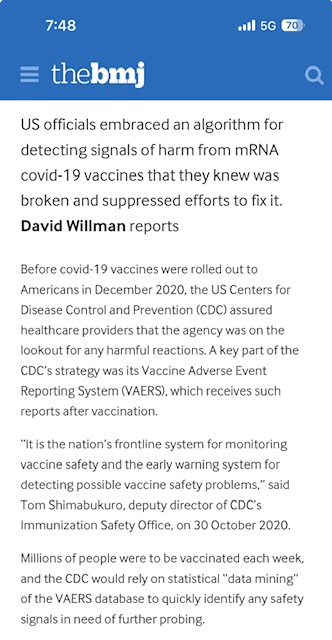
US officials embraced an algorithm for detecting signals of harm from mRNA covid-19 vaccines that they knew was broken and suppressed efforts to fix it. David Willman reports
Before covid-19 vaccines were rolled out to Americans in December 2020, the US Centers for Disease Control and Prevention (CDC) assured healthcare providers that the agency was on the lookout for any harmful reactions. A key part of the CDC’s strategy was its Vaccine Adverse Event Reporting System (VAERS), which receives such reports after vaccination.
“It is the nation’s frontline system for monitoring vaccine safety and the early warning system for detecting possible vaccine safety problems,” said Tom Shimabukuro, deputy director of CDC’s Immunization Safety Office, on 30 October 2020.
Millions of people were to be vaccinated each week, and the CDC would rely on statistical “data mining” of the VAERS database to quickly identify any safety signals in need of further probing.
Two well recognised, separate algorithms were to be used. The first involved calculating “proportional reporting ratios” (PRRs), which sought to identify types of reactions reported to VAERS disproportionately or more frequently than background rates. The second data mining technique, called “empirical bayesian,” was to be provided by the Food and Drug Administration (FDA), which operated VAERS jointly with the CDC, and the two agencies planned to share and discuss results.1
But in a little noticed September 2022 letter, CDC director Rochelle Walensky said that the agency did not perform PRR analyses for signals until 2022. This was more than a year into the vaccine rollout and was intended, she wrote, “to corroborate” the FDA’s approach. Instead of using the PRR and empirical bayesian methods jointly during the pandemic, Walensky explained that both the CDC and FDA instead “chose to rely” on empirical bayesian, which she characterised as “a more robust technique.”
The BMJ, however, has found that the FDA’s algorithm was mathematically compromised by the deluge of covid vaccine adverse event reports—resulting in a near total loss of signal detection sensitivity for the new mRNA vaccines made by Pfizer and Moderna. Top FDA officials were warned internally of this problem in early 2021, and the official who headed its pharmacovigilance division for vaccines commented more than two years later to his CDC and FDA colleagues: “We were aware of this [data mining] limitation before and during the pandemic.” Government documents also show that CDC officials were informed during rollout of the vaccines—on multiple occasions.
Yet instead of fixing the safety deficiency—or shutting down the unreliable signal detection system—officials continued to rely on the FDA’s broken algorithm. The officials also cited the absence of signals when assuring clinicians and the public of the vaccines’ safety.
At the FDA, managers went a step further by silencing the career drug safety officer who had repeatedly brought the deficiency to their attention and had offered an updated algorithm intended to fix it. As a result, Americans received unfounded assurances of the safety of the most widely used covid vaccines and were denied prompt warnings of potential harms, The BMJ’s investigation found.
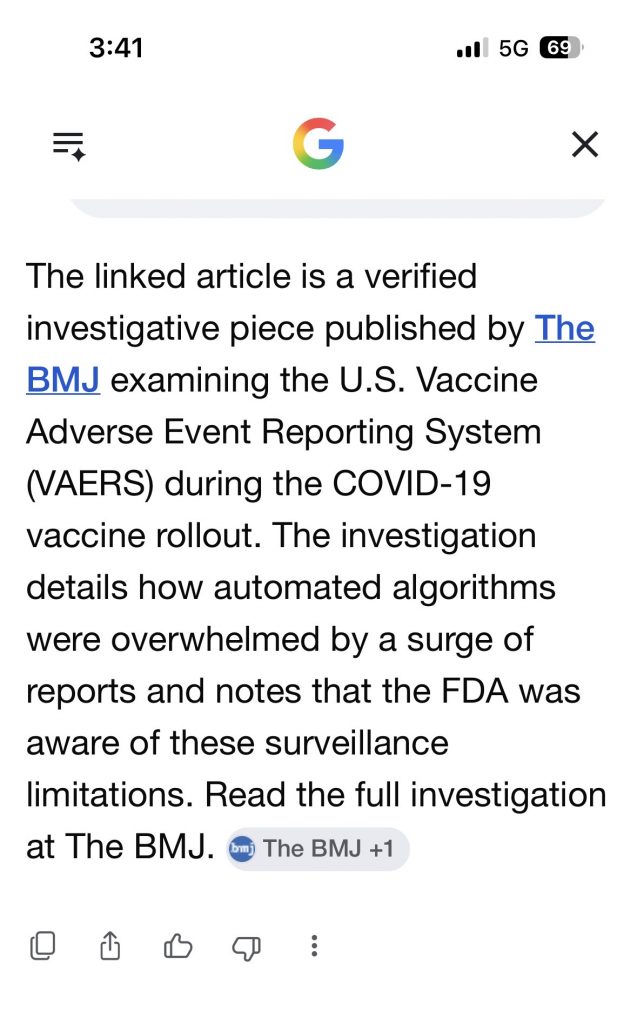
The full report is in the following link :
https://www.bmj.com/content/394/bmj-2026-100806