First Love

In Rev 2:4-5 on the Ephesus church,  “the love you had at first” is best understood as the church’s former love for Christ expressed in wholehearted devotion to Him – a love that had once animated its obedience, service and relationship with Him.  The striking thing is that Ephesus had not become doctrinally apostate. It was working hard, enduring hardship, rejecting false teachers, and testing those who claimed to be apostles.

1. First love is more than emotional affection.

Jesus was not simply saying, “You don’t feel as passionate as you used to.”  The surrounding passage shows that their problem was deeper. They were doing many right things, but the love that should have been the SOURCE and motivation of those things had diminished.  This is very similar to what Paul says in 1 Cor 13:3 :  “If I give away all I have… but have not love, I gain nothing.”

So a church can have sound doctrine, biblical discernment, hard work, perseverance, opposition to false teaching, and yet lose the love that makes those things pleasing to Christ.

2. What was their first love directed toward?

The Ephesian believers had originally received the gospel with a great devotion to Jesus. Their Christian life flowed from that relationship. But over time, the work of defending truth could continue even after the love for the Lord had cooled.

There is an important distinction:

They had not necessarily stopped serving Christ; they had stopped loving Him as they once did.  That is why Jesus doesn’t merely say, “Stop doing these things.” He says: “Remember therefore from where you have fallen; repent, and do the works you did at first.”  Rev 2:5.

The sequence is important: remember…repent…return to the works that flowed from that love.

3. “Do the first works” gives us a clue.

What were the “first works”?  No list was mentioned but I believe they are the works that characterized their original love and devotion to Christ. In other words:

Do again what you did when your love for Me was fresh and wholehearted. The external activity might look similar, but the heart behind it is different. Someone can preach because he loves Christ or because he loves preaching. Someone can defend sound doctrine because he loves Christ or because he loves being right. Someone can serve the church because he loves Christ or because he loves ministry. Someone can evangelize because he loves Christ and lost people or because he wants to increase his ministry. The activity may be identical. The object and motivation of the heart are different.

4. There is an interesting connection with Ephesians.

This becomes especially poignant because the Ephesian church had once been remarkable for its love.  Eph 1:15; Eph 6:24.   So, historically, love for Christ and love for His people were prominent characteristics of the Ephesian church.  By Revelation 2, decades later, Jesus commends their perseverance and doctrinal vigilance but says that something central has disappeared.  That makes the warning particularly sobering – a church can become more discerning while becoming less loving.

5. First love does not mean compromising truth.

This is particularly important in light of what Jesus says immediately before the rebuke. He praises them for “testing those who call themselves apostles and are not” and for hating “the works of the Nicolaitans, which I also hate.”  So Jesus does not tell Ephesus to become less discerning or more tolerant of false doctrine in order to recover love.Rather, He is saying “Keep your hatred of evil—but recover your love for Me.” Christian love and doctrinal faithfulness are not opposites. In fact, the greatest danger is when defending truth becomes detached from loving the Truth Himself.

6. The deepest issue: Christ wants the heart, not merely the work.

I think this is the heart of the passage. Ephesus had become a church that could say: “We know what is true. We know what is false. We have endured. We have labored.” And Jesus essentially says: “But do you still love Me?”  That is why the warning is so severe:  “If not, I will come to you and remove your lampstand from its place, unless you repent.”  Rev 2;5. The lampstand represents the church’s witness. Orthodoxy, activity and perseverance cannot substitute for love for Christ.

So what is “first love”?   First love is the wholehearted love and devotion to Christ that characterized the believer’s or church’s early walk with Him—a love that naturally expresses itself in obedience, fellowship with Him, love for His people, and joyful service. And notice the beautiful paradox.  Jesus doesn’t tell Ephesus merely to work harder. He tells them to return to the relationship from which the works originally came. That is why I think Revelation 2:4 is one of the most searching warnings to a doctrinally sound church. It is possible to be right about Jesus while gradually losing your love for Jesus. And perhaps that is precisely why Christ puts “remember” before “repent.” They had to remember what it was like when Christ Himself—not merely His work, His truth, or His church—was the great love of their lives.

Global Financial “Perfect Storm” ?

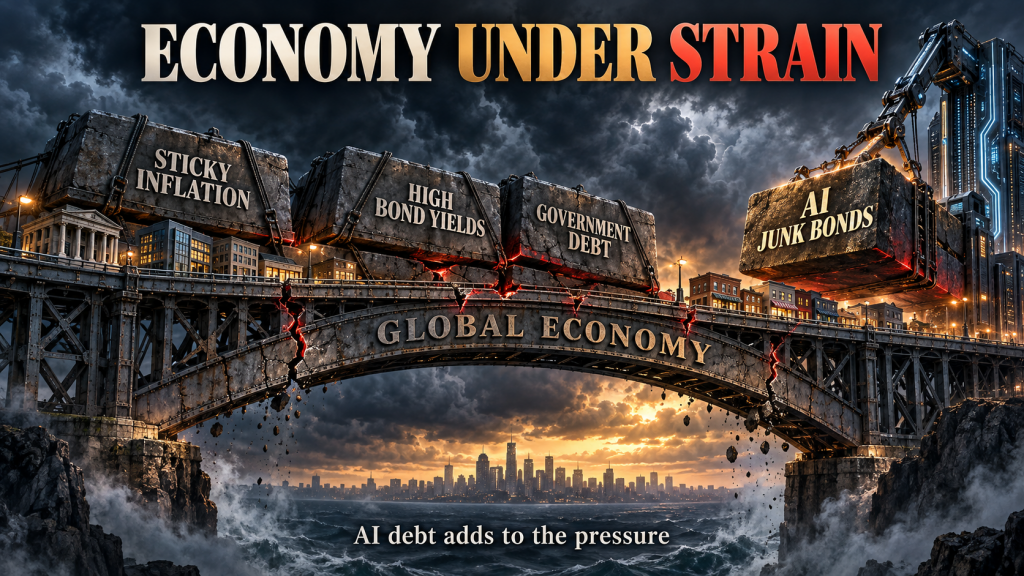
The combination of sticky inflation, soaring bond yields and staggering global debt has indeed created what many market analysts are calling a “perfect storm” in global financial markets.  The primary catalyst accelerating this crisis is an unprecedented “capital scarcity” dynamic driven by the AI infrastructure buildout.   Tech hyperscalers have issued a massive USD 220 billion in bonds so far this year to fund data centers.  This SUDDEN, MASSIVE corporate issuance directly competes with sovereign debt for investor capital.  With governments already running massive deficits (eg US total debt surpassing USD 40 trillion), this flood of new bonds has driven global yields to multi-decade highs.  The US 10 year Treasury yield has spiked above 5.3% and 30-year mortgage rates have breached 7%, putting severe structural pressure on both the housing market and banking balance sheets.

Anatomy of the “Perfect Storm”

To understand how these elements compound each other, we must look at how the macroeconomic pressures feed into one another.

The AI Capital Crunch.

Major tech companies (like Alphabet, Amazon and Meta) are issuing hundreds of billions in debt to fund AI cap-ex.  This massive corporate supply shifts the balance of capital allocation.  To attract buyers, both corporations and governments must offer increasingly higher yields. 

Energy-Driven Inflation.

Tensions between the US and Iran have pushed Brent crude past USD 100 per barrel, keeping headline inflation stubbornly high.  This prevents central banks from easing monetary policy,  locking interest rates at “higher-for-longer” levels.

The Sovereign Debt Burden.

Servicing legacy sovereign debt at more than 5% interest is becoming a wealth degrading loop.  In major G7 economies (excluding Germany), debt to GDP ratios sit at or above 100% leaving governments with dwindling fiscal room to maneuver.

Why It Might Trigger A Crash (The Bear Case)

Corporate Credit Widening.   As credit default swaps (CDS) spreads widen across AI infrastructure data centers and “neo clouds”,  fears of an AI debt bubble are emerging.  If AI monetization falls short of these massive borrowing costs, a wave of downgrades could trigger systemic corporate defaults.

Banking And Systemic Illiquidity.   Rapidly rising yields cause massive unrealized capital losses on older, lower coupon bonds held by commercial banks, insurers and pension funds.  This mirrors the underlying mechanics of previous banking panics. 

Economic Suffocation.   Squeezing ordinary consumers via more than 7% mortgages and expensive energy, while simultaneously driving up corporate borrowing costs,  threatens to stall global growth entirely.

Why The System Might Hold (The Bull Case)

AI Productivity / Earnings Offset.  Tech giants are actively backing their debt with soaring revenues.  Strong earnings reports from key hardware providers like Micron Technology demonstrates that underlying demand for AI remains highly robust. 

Economic Resiliency.   Consumer spending and median wage growth remain strong.  If the geopolitical energy shock subsides and oil supplies normalize, inflation could cool without requiring a deep recession.

Which Is More Probable – The Bear Or Bull Case ?

Pointing to current record sales as proof of safety today does not equal cash flow sustainability tomorrow if the underlying infrastructure is financed by an unpayable mountain of debt.  The credit markets are already shouting this warning. 

The tech sector is locked in a dangerous mismatch between the timing of capital expenditures and the timing of monetization. 

The 2030 Profit Gap.  Hyperscalers and data center operations are borrowing hundreds of billions right now to buy chips and build out infrastructure.  Yet broad enterprise AI profitability – the point where regular companies derive enough measurable value from AI to justify trillions in software spend – is widely projected to be a post-2030 reality.

The Descent Toward Junk.  We are already seeing major cracks.  Oracle Corporation has seen its massive USD 250 billion debt load push its credit rating to the absolute lowest rung of investment grade.  Its Credit Default Swaps have spiked an its banks have recently struggled to sell USD 18 billion in data center debt even at DEEP DISCOUNTS.  If tech stalwarts face downgrades to junk status,  it will trigger forced selling from institutional funds, cutting off the liquidity machine entirely.

The Illiquidity Of “Neo-Clouds”.   Much of the immediate demand for chips has been driven by specialized, venture backed “neo cloud” providers using debt to buy hardware.  If these entities run out of cash before the software monetization arrives,  their buying stops instantly. 

The Verdict : A Compounded Crisis.

If the revenue side of AI stalls while hundreds of billions in corporate bonds sit on the edge of a junk downgrade, it will trigger a vicious feedback loop.  Higher borrowing costs will force tech companies to slash capital spending, causing a direct, rapid collapse in hardware sales for companies like Micron. 

What is your verdict ?    I believe that biblical prophecy will definitely be fulfilled.  I believe in the destruction of all wealth of Babylon and her allies as prophesized in Rev 18:17-19.

Writing My Second Book

I had always wanted to write a second book – this time, a memoir of my life before the pandemic. Sometime in July, I discovered that AI could help arrange the gospel songs I had composed over the years. The results were so impressive that I was able to release the songs on streaming platforms such as Apple Music, Amazon Music, Spotify, iTunes and YouTube Music. I believe the Lord has answered my prayer eventually in His timing. All praise to Him !

That experience made me wonder: Could AI also help me turn the many stories of my life into a book, without my having to worry too much about the flow, the central theme or the grammar?

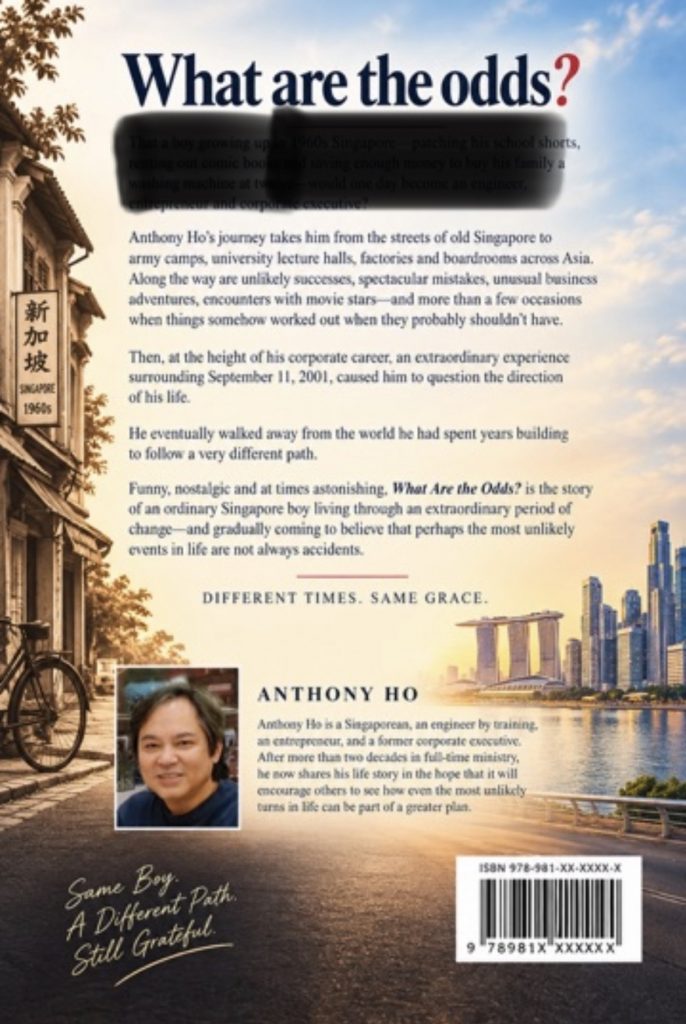
Indeed, it could. AI helped me proofread, edit and organise my stories into a coherent manuscript. In just one week, I completed the writing, and AI helped transform it into a polished manuscript ready for publication. It even helped create the designs for the front and back covers.

What had remained only a dream for years finally became a reality. The Lord has indeed answered my prayer in His timing. ALL GLORY TO GOD !

In the preface of this book, I wrote :

In this book, I hope to share my life experiences—the vagaries of life, the amusing and the incredible, the hilarious and the sorrowful—from my growing-up years in Singapore in the 1960s to the present. I hope to tell these stories without theological bias, simply sharing them as I remember them.

It was the movie Forrest Gump that inspired me to write this book. But unlike the hilarious chance happenings and improbable episodes in the life of Forrest Gump, I believe in the sovereignty of God over every incident of my life.

I was born in 1960 and have lived through so many phases of technological and societal change. Singapore itself has been transformed almost beyond recognition during my lifetime. I have therefore seen, experienced and sometimes stumbled my way through a remarkable period of change.

My hope is that these stories will at the very least make this an entertaining—and perhaps even hilarious—read. But more than that, I hope that somewhere among the laughter, the surprises and the sorrows, you will see a little of the Singapore that I grew up in, and perhaps a little glimpse of the hand of God behind it all.

Screenshot