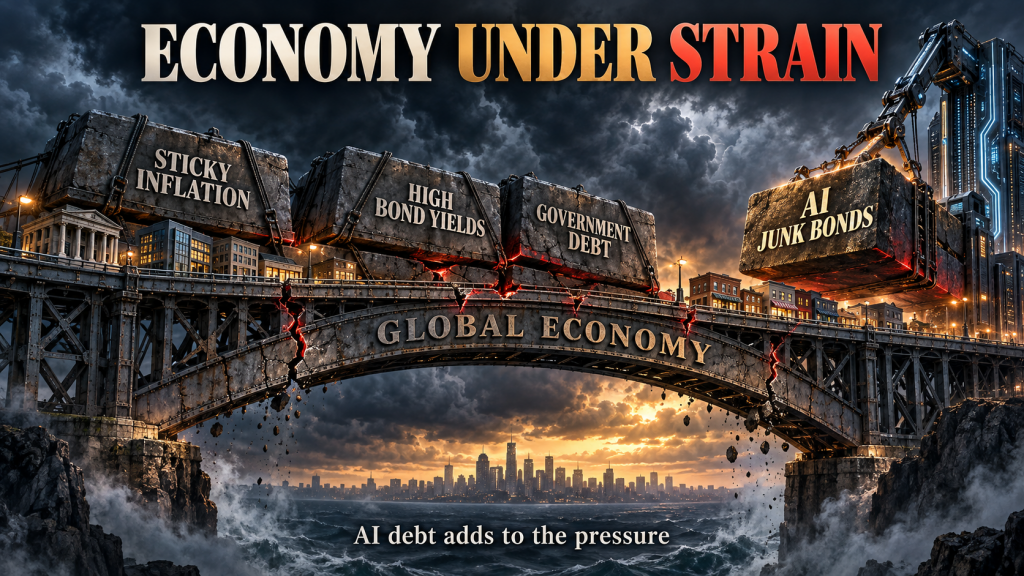
The combination of sticky inflation, soaring bond yields and staggering global debt has indeed created what many market analysts are calling a “perfect storm” in global financial markets. The primary catalyst accelerating this crisis is an unprecedented “capital scarcity” dynamic driven by the AI infrastructure buildout. Tech hyperscalers have issued a massive USD 220 billion in bonds so far this year to fund data centers. This SUDDEN, MASSIVE corporate issuance directly competes with sovereign debt for investor capital. With governments already running massive deficits (eg US total debt surpassing USD 40 trillion), this flood of new bonds has driven global yields to multi-decade highs. The US 10 year Treasury yield has spiked above 5.3% and 30-year mortgage rates have breached 7%, putting severe structural pressure on both the housing market and banking balance sheets.
Anatomy of the “Perfect Storm”
To understand how these elements compound each other, we must look at how the macroeconomic pressures feed into one another.
The AI Capital Crunch.
Major tech companies (like Alphabet, Amazon and Meta) are issuing hundreds of billions in debt to fund AI cap-ex. This massive corporate supply shifts the balance of capital allocation. To attract buyers, both corporations and governments must offer increasingly higher yields.
Energy-Driven Inflation.
Tensions between the US and Iran have pushed Brent crude past USD 100 per barrel, keeping headline inflation stubbornly high. This prevents central banks from easing monetary policy, locking interest rates at “higher-for-longer” levels.
The Sovereign Debt Burden.
Servicing legacy sovereign debt at more than 5% interest is becoming a wealth degrading loop. In major G7 economies (excluding Germany), debt to GDP ratios sit at or above 100% leaving governments with dwindling fiscal room to maneuver.
Why It Might Trigger A Crash (The Bear Case)
Corporate Credit Widening. As credit default swaps (CDS) spreads widen across AI infrastructure data centers and “neo clouds”, fears of an AI debt bubble are emerging. If AI monetization falls short of these massive borrowing costs, a wave of downgrades could trigger systemic corporate defaults.
Banking And Systemic Illiquidity. Rapidly rising yields cause massive unrealized capital losses on older, lower coupon bonds held by commercial banks, insurers and pension funds. This mirrors the underlying mechanics of previous banking panics.
Economic Suffocation. Squeezing ordinary consumers via more than 7% mortgages and expensive energy, while simultaneously driving up corporate borrowing costs, threatens to stall global growth entirely.
Why The System Might Hold (The Bull Case)
AI Productivity / Earnings Offset. Tech giants are actively backing their debt with soaring revenues. Strong earnings reports from key hardware providers like Micron Technology demonstrates that underlying demand for AI remains highly robust.
Economic Resiliency. Consumer spending and median wage growth remain strong. If the geopolitical energy shock subsides and oil supplies normalize, inflation could cool without requiring a deep recession.
Which Is More Probable – The Bear Or Bull Case ?
Pointing to current record sales as proof of safety today does not equal cash flow sustainability tomorrow if the underlying infrastructure is financed by an unpayable mountain of debt. The credit markets are already shouting this warning.
The tech sector is locked in a dangerous mismatch between the timing of capital expenditures and the timing of monetization.
The 2030 Profit Gap. Hyperscalers and data center operations are borrowing hundreds of billions right now to buy chips and build out infrastructure. Yet broad enterprise AI profitability – the point where regular companies derive enough measurable value from AI to justify trillions in software spend – is widely projected to be a post-2030 reality.
The Descent Toward Junk. We are already seeing major cracks. Oracle Corporation has seen its massive USD 250 billion debt load push its credit rating to the absolute lowest rung of investment grade. Its Credit Default Swaps have spiked an its banks have recently struggled to sell USD 18 billion in data center debt even at DEEP DISCOUNTS. If tech stalwarts face downgrades to junk status, it will trigger forced selling from institutional funds, cutting off the liquidity machine entirely.
The Illiquidity Of “Neo-Clouds”. Much of the immediate demand for chips has been driven by specialized, venture backed “neo cloud” providers using debt to buy hardware. If these entities run out of cash before the software monetization arrives, their buying stops instantly.
The Verdict : A Compounded Crisis.
If the revenue side of AI stalls while hundreds of billions in corporate bonds sit on the edge of a junk downgrade, it will trigger a vicious feedback loop. Higher borrowing costs will force tech companies to slash capital spending, causing a direct, rapid collapse in hardware sales for companies like Micron.
What is your verdict ? I believe that biblical prophecy will definitely be fulfilled. I believe in the destruction of all wealth of Babylon and her allies as prophesized in Rev 18:17-19.