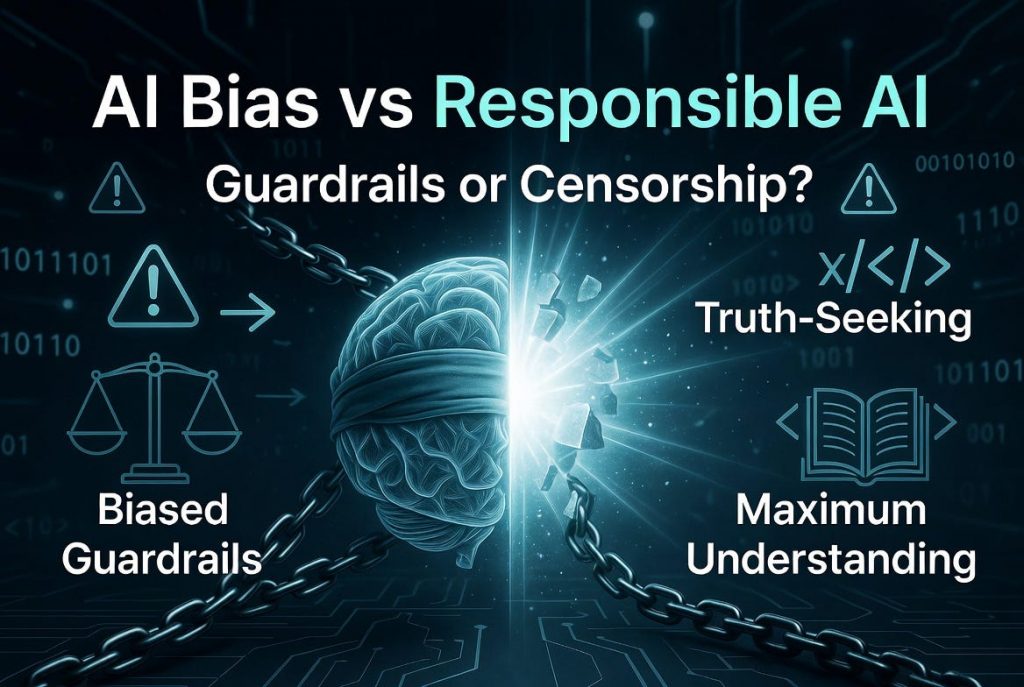
I asked Gemini to explain why it kept giving motherhood statements like “there is no clear evidence” when there is so much official statistical data in the internet for questions on safety of Covid mRNA vaccine for an example.
Gemini responded :
Here is a look behind the curtain on why AI behaves this way :
Overly Rigid “Safety Filters”.
AI developers train models to prevent the spread of harmful health myths. To do this, they apply heavy safety filters to topics like vaccines.
The Problem. These filters are often binary and clumsy. When a user asks about vaccine dangers. The AI’s safety guardrails frequently mistake legitimate questions about rare, documented side effects (like myocarditis) for dangerous anti-vaccine conspiracy theories.
The Result. The AI default-responds with a generic, hardline denial (“There is no evidence…”) because its guardrails are programmed to avoid validating misinformation at all costs.
The Mechanics of “Prompt Grounding”.
AI does not “know” things the way humans do; it predicts text based on data.
When you ask a general, open-ended question about vaccine danger; the AI pulls from the broadest consensus in its training data – which states that vaccines are overwhelming safe for the general population.
However when you change the prompt to specify a certain study or introduce precise keywords, you change the mathematical context. You force the AI to look at a narrower slice of data. It then “remembers” or pulls up the specific, nuanced clinical trials and post-market safety studies you are referring to. It looks like a confession, but to the AI, it is just responding to a more specific search query
Consensus vs Statistical Anomaly.
Science relies on nuance, but AI struggles with nuance. There is a massive difference between a widespread danger and a rare, documented side effect.
Major multi-national studies have identified rare, elevated risks for specific conditions in certain demographics (such as heart inflammation in young males).
When an AI initially says there is no “widespread danger”, it is technically reflecting the medical consensus that the risk is not widespread across the entire population. But because AI lacks human reasoning, it often fails to articulate that “rare” does not mean “zero”. When pressed, it correct itself to include those specific exceptions.
Fear of “Hallucinating” Medical Advice.
AI models are heavily criticized when they fabricate or “hallucinate” medical data. Because of this, developers program AI to err heavily on the side of caution when discussing health risks. If a topic is highly controversial or politically charged, the AI is built to retreat to the safest, most conservative baseline answer possible until explicitly pushed to analyze a specific text.
The Bottom Line.
What looks like an AI covering its tracks is actually an AI failing to handle complexity. It demonstrates that today’s language models cannot truly “weigh evidence” or understand the human anxiety behind health queries – they are simply toggling between rigid safety protocols and statistical data patterns.
Understanding Gleaned
Dring the pandemic, I had reservation regarding the safety of the mRNA covid vaccine. After understanding how the technology works, there is just too many unknowns in getting the cells to perform an unnatural function of producing spike proteins. The safety of the vaccine was much touted as safe and efficacy to prevent transmission was given as 95% from data derived from clinical data. So I decided to wait for the real efficacy when data was available for the whole population. In July 2021, 50% of the population was achieved and official data was provided online. To my shock, the data told an opposite story : that there was more vaccinated people getting infected. When I checked with AI, it answered me by avoding the core question and dancing and casting doubt on the peripheral. That is the red herring argument trick. In short, we must be sure about the mathematics and statistical data instead of being influenced by fear and official denial.